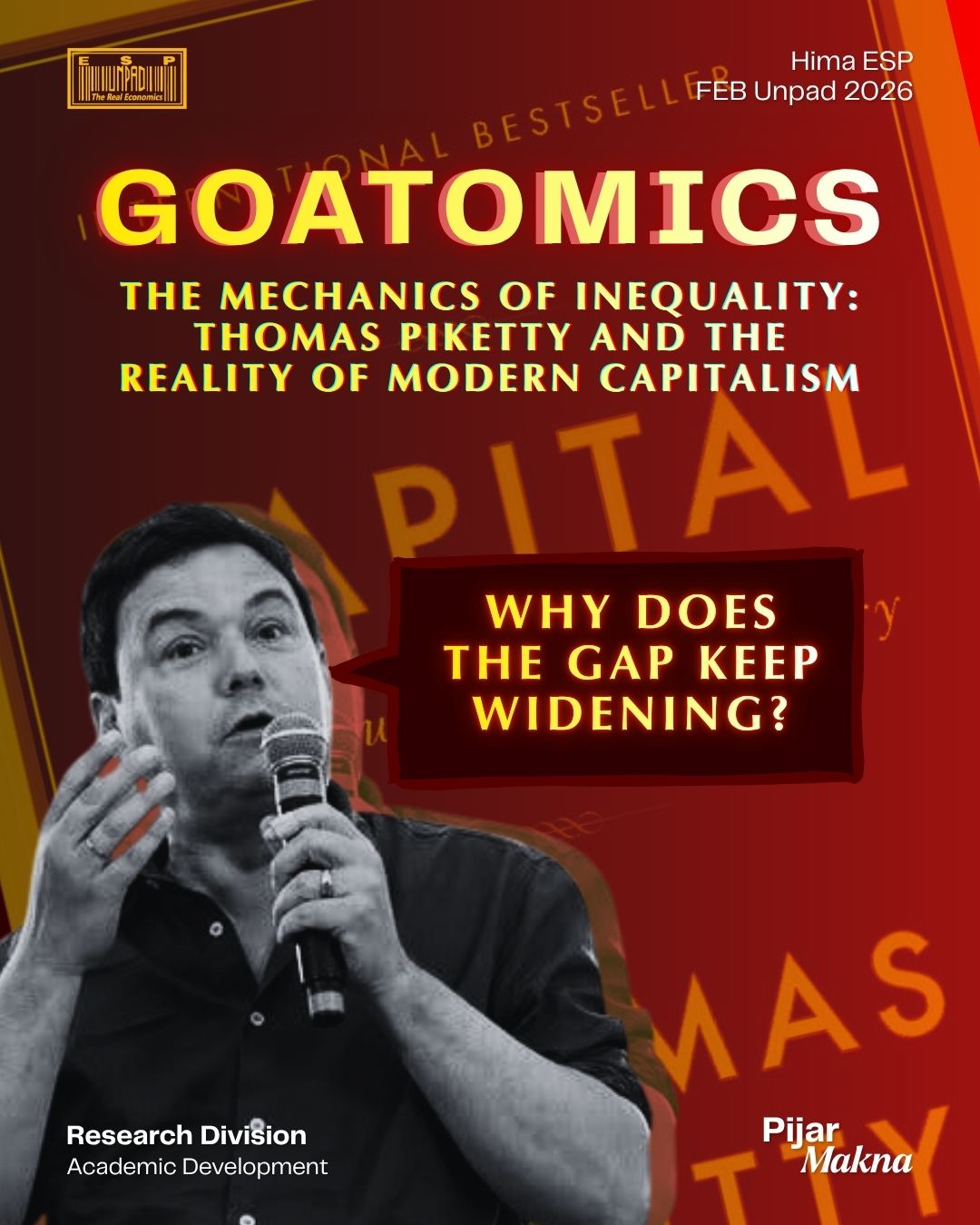
Recently, the public was shaken by the case of an elementary school student in Nusa Tenggara Timur, Indonesia, who committed suicide because they lacked the financial means to buy school necessities. It is truly heartbreaking to think how a child could be driven to such an act simply because their mother did not have 10,000 rupiahs to buy a notebook and a pen. Meanwhile, reports in early 2026 show that the wealth of a handful of the world’s billionaires continues to skyrocket uncontrollably. There is a stark contrast between someone struggling intensely for a meager amount of money while others accumulate wealth with such ease. This raises a frequent question when observing the modern economy, why is the inequality gap widening between the super-rich and the rest of society? Why do the wealthy seem to accumulate wealth with such ease? Thomas Piketty offers a clear explanation for this in his book, Capital in the Twenty-First Century.
Who’s Thomas Piketty?
Thomas Piketty, a French economist born on May 7, 1971, is a pivotal figure behind the modern discourse on inequality. Born to militant Trotskyite parents and later politically affiliated with the French Socialist Party, he developed a deep interest in social and economic dynamics. Academically, his track record is brilliant. He earned a master’s degree in mathematics from the École Normale Supérieure (ENS) in 1990. Three years later, he successfully obtained a Ph.D. in economics from the École des Hautes Études en Sciences Sociales (EHESS) and the European doctoral program at the London School of Economics for his dissertation on the theory of wealth redistribution. His academic career was further solidified when he was appointed as a professor at EHESS and entrusted as the founding director of the Paris School of Economics. His dedication to researching income issues is also evidenced by his collaboration with several world-renowned economists, such as Emmanuel Saez, Anthony B. Atkinson, and Facundo Alvaredo, in pioneering the World Top Incomes Database.
The pinnacle of his career as an economist was marked by the release of his major work, which examines the concentration and distribution of wealth over the last 250 years. This work did not immediately impact the world upon its initial release. The original French edition, Le Capital au XXIe siècle (2013), received positive reviews in his home country, but its reach remained quite limited. The book truly gained global momentum and sparked widespread debate a year later, specifically when the English translation, Capital in the Twenty-First Century, was published in 2014. It was through this publication that Piketty established himself as one of the most influential critics of the modern economic system.
r > g as the Core Mechanism of Inequality
In his book, Capital in the Twenty-First Century, Thomas Piketty formulates a model where r > g.
r (rate of return on capital): the amount of wealth people earn from their investments, such as stock dividends, property rentals, interest from savings, etc.
g (economic growth rate): How much the economy grows and how much wages generally rise.
According to Piketty, if r is greater than g in the long run, the wealth of those who already own capital will grow faster than the income of ordinary people who rely solely on wages. Consequently, wealth becomes increasingly concentrated, and the gap between the rich and the poor widens.
A concrete real-world example of r > g in modern capitalism can be seen in the stark divergence between billionaire wealth and average worker wages. According to the Inequality Inc. report published by Oxfam International in 2024, the wealth of the world’s richest individuals has surged exponentially over recent decades. This massive accumulation is largely driven by stock market returns, corporate dividends, and asset appreciation. In contrast, the wages of ordinary workers have barely kept pace with inflation, reflecting a sluggish overall economic growth rate (g). Because the wealthy derive their income from high-yielding capital (r) rather than daily labor, their fortunes compound at a rate far exceeding the income growth of the general population. Meanwhile, the earnings of the working class are mostly consumed by daily living expenses. This dynamic illustrates how, in many cases, the rate of return on capital (r) naturally grows faster than the growth of income or the overall economy (g).
What Happens When r > g is Left Unchecked
If this situation continues over the long term and encompasses a broader economic scale, capital owners will have more freedom to expand their wealth through asset accumulation. Meanwhile, the group of people who can only rely on labor wages will find it increasingly difficult to keep up with the wealth growth of the elite. Ultimately, this condition directly triggers wealth concentration—a phenomenon where extreme wealth accumulates and centers in the hands of a small few.
According to Piketty’s analysis, allowing this trend of inequality to continue unchecked could slowly drag our economic system back to the era of Patrimonial Capitalism. In short, this is a system where wealth obtained through family inheritance is far more dominant and valuable than what is earned through personal effort. If this inheritance-based structure becomes deeply rooted, it will ultimately lead to the rise of the rentier society. The re-emergence of this rentier class refers to a group of people who can live comfortably and constantly enrich themselves purely from the returns on their assets, without having to actually participate in productive work.
Critiques and Relevance of Piketty’s Theory
Although economists acknowledge the value of Piketty’s historical data for mapping past economic structures, its use as a predictive model is widely rejected. This pushback arises because his approach relies on somewhat unrealistic assumptions regarding capital-labor substitution. Addressing this, economist Matthew Rognlie demonstrated that the surge in capital inequality was actually driven by aggressive growth in housing values, rather than a general increase in productive capital. Furthermore, economists Per Krusell and Tony Smith highlighted a flaw in Piketty’s savings formula; upon correction, they found that an economic slowdown would not cause the capital ratio to explode as Piketty predicted, but rather increase only marginally.
The notion that the wealthiest will perpetually accumulate wealth without limit has also been debunked. Larry Summers noted that the wealthy still spend a significant portion of their fortunes, and this consumption is sufficient to curb the runaway wealth accumulation that Piketty feared. Moreover, Piketty’s primary claim regarding the r > g formula has been fundamentally questioned. Based on research by Daron Acemoglu and James Robinson across 28 countries, the gap between interest rates and economic growth actually exhibits a negative correlation with wealth concentration (the exact opposite of Piketty’s prediction).
From these critiques, it is clear that Piketty’s model has certain gaps. However, his core idea of r > g remains a vital starting point to understand how wealth accumulation worsens inequality. Therefore, his theory shouldn’t be the only answer. It becomes far more relevant when we look at it alongside other real-world factors, such as government policies and market dynamics.
Realistic Approaches to Bridging the Wealth Gap
In the author’s view, several practical policies drawn from both Piketty and his critics can be realistically implemented to reduce this inequality. Therefore, instead of enforcing policies that merely “punish” the wealth of the upper class, it is far better to shift towards concrete efforts to narrow the income gap within society.
A more rational and sustainable solution is to prioritize the enhancement of national productivity and the ease of doing business. Concrete steps can begin with massive investments in the education system so that the workforce can acquire high-level skills. Consequently, their wages can naturally increase and catch up with the returns on assets. Furthermore, the government must cut the bureaucracy that has historically made it difficult for lower-income groups to start their own businesses. If instruments for asset redistribution are still necessary, the implementation of global financial transparency and a progressive inheritance tax are considered far more realistic to manage without damaging the economic engine. Ultimately, this approach ensures that inequality is suppressed by enabling the broader society to share in the prosperity, rather than merely impoverishing those at the top.
Conclusion
The stark contrast between extreme poverty and massive wealth remains a defining challenge of modern capitalism. Thomas Piketty’s r > g framework provides a vital starting point to understand this dynamic. It illustrates how the economic structure naturally allows asset-based wealth to outpace the income earned from daily labor. If left unchecked, this inherent mechanism threatens to drag the economy back into a rentier society.
However, addressing this systemic bias requires more than just applying punitive wealth taxes. As highlighted by various economic critiques, the reality of wealth concentration is complex. A fair economic system must focus on empowering the broader workforce through practical actions. Strategic investments in education, easing business regulations, and fostering genuine wage growth offer a much more sustainable path. Ultimately, the goal is not merely to dismantle the wealth of the elite, but to build an inclusive economy where prosperity is accessible to all.
References
Britannica, T. Editors of Encyclopaedia. (n.d.). Thomas Piketty.
Encyclopedia Britannica.
https://www.britannica.com/money/Thomas-Piketty
Hardoon, D. (2015). Inequality Inc.: How corporate power divides our world and the need for a new era of public action. Oxfam International.
Karnes, G. (n.d.). Understanding Thomas Piketty and his critics.
Greg Karnes CPA.
Irawati, D. (2026, February 5). Elementary school student in NTT commits suicide, a phenomenon darker than simply having no money. Kompas.id.
Oxfam International. (2025, Januari). Billionaire wealth jumps three times faster in 2025, highest peak ever sparking global outcry.
Savage, M. (2024). Patrimonial capitalism. ResearchGate.
https://www.researchgate.net/publication/385954467_Patrimonial_Capitalism
Stilwell, F. (2015). Piketty’s capital in the twenty-first century: A multidimensional critique. Journal of Australian Political Economy, (75), 181–214.
https://journals.sagepub.com/doi/abs/10.1177/1035304615589029
 KANDANK ILMU