Introduction
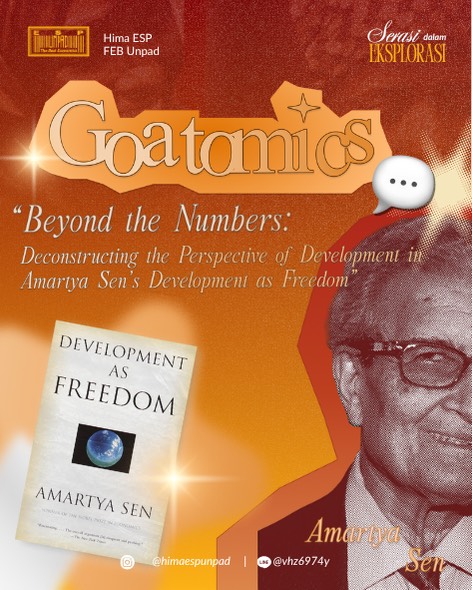
If we wonder about the standard for a nation to run its economic system in a fair, humane way, Amartya Sen’s writings will obviously emerge as the answers. Many of his works discuss equality, development, and various aspects related to people-centered issues. Those thoughts and theories which he developed contributed remarkable ideas for improving economic welfare. Therefore, he undoubtedly won the Sveriges Riksbank Prize in Economic Sciences in Memory of Alfred Nobel in 1998.
One of his most influential works is Development as Freedom, which was released in 1999, a year after he received the Nobel Prize. The book focuses on how development should be redefined and perceived as a wider, society-related scope. This book presents Amartya Sen’s thoughts on how a nation’s income, industrialization, or any quantitative metric should not be the sole standard for measuring a nation’s level of development. The capabilities of people, namely freedom, in achieving satisfaction, are another standard that is more suitable for measurement. This book also tells us refusals of Amartya Sen towards other theories, such as the Malthusian Theory of Population, which is “stricting” people’s freedom. All the values in Development as Freedom were later embodied in the Human Development Index (HDI), a well-known indicator that values a country’s development.
A Bit Story Behind The Book
The basis of Development as Freedom lies in five lectures he gave as a Presidential Fellow at the World Bank during the fall of 1996 and a follow-up lecture in November 1997. However, this book was not intended for bank-related agencies, institutions or policymakers, and planners of national governments. Instead, it was written as a general work on development aimed at fostering public discussion. He intended the book to contribute to public discussions on development. Therefore, he wrote the book to be more accessible to nonspecialist readers and kept the discussion as nontechnical as possible. All done is solely for the book to be consumed by the public and not merely by some particular societies. Moreover, he preferred putting his ideas, thoughts, and critics of this book in public domains because he wanted to maximize a space he fortunately got, which is large unimpeded media, from the country he was living in: India, Britain, and the United States.
Comprehensive Explanations of The Book
In the first chapter, Sen redefines the meaning of development through a perspective of freedom. Sen believes that wealth, often represented by income, is only instrumentally useful for achieving things that we consider worth valuing. The primary focus must be on the capability of us to be able to live first. Sen proved his arguments by empirical data showing that African-American people had a lower chance to survive until reaching mature ages than populations in China or India in 1991–1993, though they were actually poorer in terms of income than African-American people. It demonstrated that higher income does not guarantee us to have basic capabilities and development in life. Therefore, he mentioned that income is not the sole standard of development; many aspects are, especially capabilities of someone having basic rights—namely, freedom.
After redefining development as “freedom”, Sen goes on to distinguish two roles of freedom: the constitutive role (as an end) and the instrumental role (as a means). Freedom as a constitutive role means that it is the main goal of development (It is the end of the process). On the other hand, freedom as an instrumental role works like a driver of development because all different kinds of freedom interrelate and reinforce one another, invigorating the expansion of freedom in general (freedom as the meaning of a process itself). Those roles are not mutually exclusive; freedom can be the “end” and the “mean”.
Poverty, as the main indicator of a decline in development, was later redefined by Sen as the deprivation of basic capabilities rather than merely as the deprivation of aggregate income. There are lots of aspects, such as age, disability, or illness, that reduce the capability of one to earn income. These same factors also make it more difficult for people to convert income into capabilities. For example, a sick person not only has a lower capability to earn income, but also faces greater difficulty in transforming that limited income into the same level of health as a healthy person, even when purchasing medicines. This phenomenon is called the “coupling of disadvantages”, meaning the “real” poverty is too complex to merely be translated as low-level income of a person. Moreover, income alone does not capture other forms of deprivation related to development, such as the psychological and social effects of unemployment—like loss of self-respect and social exclusion—or the concept of missing women, which refers to the excess of female mortality resulting from gender equality.
Sen also notices that democracy has three important roles in development: intrinsic importance, instrumental contribution, and constructive role. Intrinsic importance means democracy intrinsically is a constitutive part of a good life, hence making it important because it is related to freedom as end. Democracy, in its instrumental contribution, serves to create political incentives—through elections, opposition, free press—for governments to respond to people’s needs. The constructive role itself is the conceptualization of people’s needs through public discussion and free participation. Lee’s Thesis, which primarily talks about authoritarianism as being conducive to economic growth, was refuted by Sen in the book. He argued that authoritarianism seemed to boost economic growth based on cherry-picking evidence and ignored the negative effects of dictatorial power. Governmental responses to people’s needs often depend on the pressure exerted on the government, and this is where the exercise of political rights—such as voting, public criticism, and peaceful protest—plays a crucial role. This is a role that democracy has but authoritarianism does not, hence making democratic countries to have better policy in overcoming general disaster than authoritarianism.
As a form of freedom to achieve development, he supported the empowerment of women’s agencies to be an engine of social change and development. He believed that nothing is as important as an adequate recognition of political, socioeconomic participation, and leadership of women. This empowerment can promote child survival and help to reduce fertility rates. Those can lead to the rise of women’s well-being, which has a tremendous contribution to economic development.
In the book, he often disagrees with a theory or prediction that either explicitly or implicitly restricts people’s freedom. He refuted Malthus’ prediction of a food-population crisis, showing that global food production per capita has continued to rise. He showed that even when there is a country that has a decline in food output, like countries in Africa, it is because of the general economic crisis not the food production crisis. He argued that Malthus’ prediction could mislead policymakers into making poor decisions, either by enforcing population-control policies—a tendency often referred to as Malthusian pessimism—or by neglecting the issue altogether when population numbers have not yet exceeded food supply, a perspective known as Malthusian optimism. Sen prefers policy or theory that is freedom-enhancing. He agrees with Condorcet’s view, emphasizing that voluntary fertility reduction happens with social development and freedom (especially women’s empowerment) and not coercive moves that are caused by Malthus’ predictions.
He also responded to much of the skepticism regarding the possibility of achieving reasoned social progress. The first theory is Kenneth Arrow’s Impossibility Theorem which simply says that it is impossible to aggregate individual preferences into a single rational social ordering without dictatorship. He responded to skepticism by explaining that Arrow’s theorem applies only to decision-making mechanisms that rely on a very limited informational base—specifically, individual ranked preferences. Sen argues that real social and economic judgments must incorporate a wider informational base, including concerns about poverty, inequality, welfare, and capabilities. By broadening the information used in evaluation, consistent, and coherent criteria for social assessment become possible without any coercive moves such as dictatorship.
Another skepticism he responded to was the skepticism of human motivation. This critique, drawing on a narrow interpretation of classical economics, depicts that human beings are motivated only by self-interest. This suggests that complex social arrangements that require cooperation, ethics, or a sense of justice can not work beyond the raw market mechanism. However, Sen rejected this “low-minded sentimentality,” arguing that people tend to move by values that go beyond narrow self-interest, such as sympathy and commitment.
Conclusion
Amartya Sen’s Development as Freedom is a book that is screaming how important freedom of mankind is for development. This book presented a particular way to perceive development in a broader scope, rather than only valuing wealthiness and income. Freedom here was explained to have two roles that work on development of a nation. In addition to redefining development, Sen also broadened the definition of its main indicator—poverty. The book also demonstrates that all major institutions—such as the government, the market, and communities—play essential roles in advancing development as freedom. Democracy, which advocates the right of people to have their voices in public, is expected to take part in establishing capabilities of people to get basic needs and freedom. This book elucidates all predictions, theories, and skepticism regarding freedom and social progress. We can see that all great explanations, points of views, and elaborations related to economic development are packed merely in one book. It does make sense if later, every value and idea in this book are totally embodied in current measurement of economic development, namely HDI (Human Development Index).
Krisnha Ahmad Fadhilah e!25
References
O’Hearn, D. (2009). Amartya Sen’s Development as Freedom: Ten Years Later. Policy and Practice: A Development Education Review.
Sen, A. (1999). Development as Freedom. Alfred A. Knopf.
The Sveriges Riksbank Prize in Economic Sciences in Memory of Alfred Nobel 1998. (1998). NobelPrize.org. https://www.nobelprize.org/prizes/economic-sciences/1998/sen/facts/
Tungodden, B. (2001). A Balanced View of Development as Freedom. Chr. Michelsen Institute.
 KANDANK ILMU