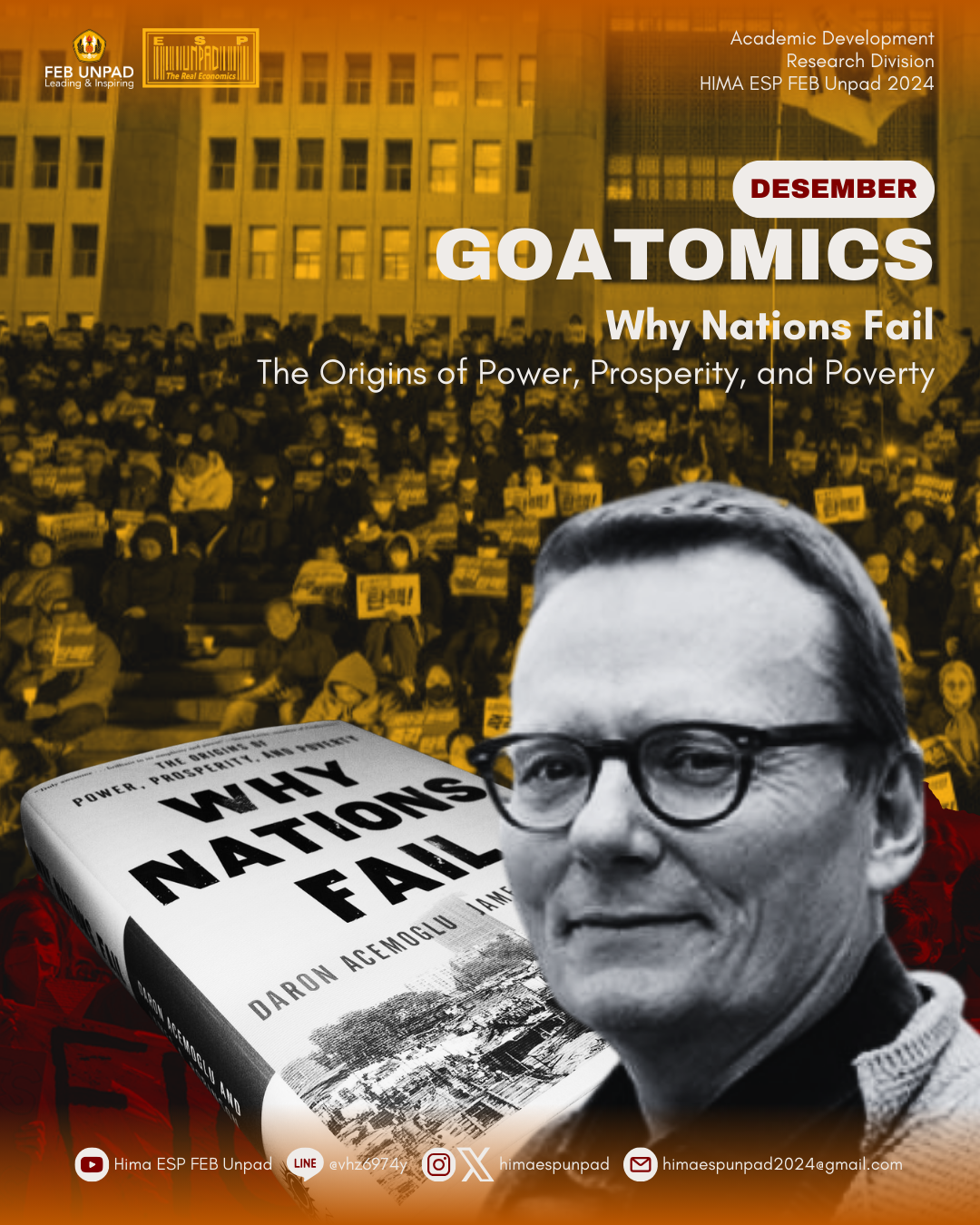
“Why Nations Fail: The Origins of Power, Prosperity, and Poverty”, by Daron Acemoglu and James A. Robinson is a comprehensive exploration of the factors that determine a nation’s economic success or failure. For example, The stark contrast between North and South Korea serves as a powerful illustration of the authors’ core thesis. Despite sharing a common heritage and ethnicity, these two nations have diverged dramatically in their economic and political development. South Korea’s remarkable economic ascent, characterized by rapid industrialization and technological innovation, can be attributed to its adoption of inclusive institutions that fostered entrepreneurship, protected property rights, and encouraged competition. In contrast, North Korea’s oppressive regime and extractive institutions have stifled economic growth, perpetuated poverty, and denied its citizens basic freedoms. This stark disparity underscores the critical role of institutional quality in shaping a nation’s prosperity and well-being. South Korea in this context has managed to achieve a high level of well-being and has demonstrated stable high rates of economic growth for a long time: this state of the economy is called sustainable development.
1. Why Nations Fail?
- Institutions Matter
Daron Acemoglu and James A. Robinson argue that the fundamental determinant of a nation’s prosperity or poverty lies in the quality of its institutions. They differentiate between two primary types of institutions:
Extractive Institutions These institutions are characterized by a concentration of power in the hands of a narrow elite, who exploit the majority of the population for their gain. Such institutions often manifest as corrupt governments, monopolies, and crony capitalist systems. They stifle innovation by discouraging risk-taking and competition, hinder investment by creating uncertainty and insecurity, and perpetuate inequality by limiting opportunities for social and economic mobility. As a result, nations with extractive institutions tend to experience stagnation, poverty, and conflict.
| Feature | Extractive Institutions | Inclusive Institutions |
| Power Distribution | Concentrated | Stagnation |
| Economic Participation | Limited | Broad |
| Economic Participation | Insecure | Secure |
| Innovation | Discouraged | Encouraged |
| Economic Outcome | Stagnation | Growth |
Inclusive Institutions In contrast, inclusive institutions are characterized by broad-based participation, the protection of property rights, and the enforcement of the rule of law. These institutions foster innovation by incentivizing creativity and entrepreneurship, encourage investment by providing a stable and predictable environment, and promote economic growth by creating opportunities for all. Democratic governments, free markets, and independent judiciaries are hallmarks of inclusive institutions.
Nations endowed with such institutions tend to experience sustained economic growth, social progress, and political stability. Nations with inclusive institutions tend to prosper, while those with extractive institutions tend to fail.
- How Past Events Shape Future Institutions
Critical junctures, such as revolutions or economic crises, are pivotal moments that can radically alter a nation’s path. The choices made during these junctures can have long-lasting consequences. Once certain institutions are established, they can become entrenched, making it difficult to break free from them, even if they are no longer optimal. This is known as institutional lock-in, and it often occurs due to vested interests in maintaining the status quo. Additionally, small initial differences, such as technological advancements or educational disparities, can lead to significant disparities over time. A slight advantage can lead to a virtuous cycle of growth and development, while a disadvantage can lead to a vicious cycle of poverty and underdevelopment.
While historical path dependence can make it difficult to break free from extractive institutions, but still it is not impossible. Significant institutional change can occur through various means, such as political reform, economic liberalization, social movements, and foreign influence. Democratic reforms can empower the population and allow for greater participation in decision-making. Market-oriented reforms can promote economic growth and reduce the power of the state. Social movements can mobilize public opinion and pressure the government to implement reforms. International aid and investment can provide resources and expertise to support institutional change.
In conclusion, historical path dependence is a powerful force that can shape a nation’s destiny. Understanding its impact is crucial for policymakers and citizens who seek to build more inclusive and prosperous societies.
- The Role of the Elite
Political power, the ability to influence and control the actions of others, is a fundamental force shaping societies. It determines the distribution of resources, the enforcement of laws, and the overall direction of a nation. However, the concentration of power in the hands of a select few can lead to significant societal imbalances and injustices.
An elite class, often comprised of wealthy individuals, corporations, or specific social groups, can wield disproportionate influence over political institutions. They may use their resources to lobby for favorable policies, manipulate public opinion, or even undermine democratic processes. This elite control can stifle innovation, perpetuate inequality, and hinder social progress.
To counterbalance the power of the elite, societies must periodically undergo periods of political upheaval. These upheavals, often in the form of revolutions or social movements, challenge the status quo and demand greater representation and participation for marginalized groups. Successful nations have a history of such challenges, which have led to institutional reforms, increased accountability, and a more equitable distribution of power.
2. Power, Prosperity, and Poverty
- Power
In “Why Nations Fail,” power is not merely the ability to influence; it’s a complex interplay of economic, political, and social factors. Acemoglu and Robinson argue that power, when concentrated in the hands of a narrow elite, becomes a tool to maintain the status quo, often through extractive institutions. This elite manipulates economic policies, controls political processes, and shapes societal norms to perpetuate their dominance.
This concentration of power stifles innovation, discourages investment, and limits opportunities for the broader population. It creates a vicious cycle where the elite’s wealth and influence grow while the majority remains trapped in poverty and inequality. The authors emphasize that true power lies not in coercion or exploitation but in the ability to create inclusive institutions that empower citizens, foster economic growth, and promote social justice. By understanding the dynamics of power, we can work towards building societies that are equitable, prosperous, and resilient.
- Prosperity
In “Why Nations Fail,” prosperity is intricately tied to the quality and inclusivity of a nation’s institutions. Acemoglu and Robinson contend that inclusive institutions are the bedrock of prosperity. These institutions foster an environment where:
- Property rights are protected: This encourages investment and innovation, as individuals and businesses are assured that their assets and the fruits of their labor are secure.
- Contracts are enforced: This builds trust and facilitates economic exchange, making it easier for businesses to operate and grow.
- Fair competition is allowed: This prevents monopolies and encourages entrepreneurship, leading to greater efficiency, lower prices, and a wider range of choices for consumers.
- The government is accountable and responsive to the needs of the population: This ensures that the government serves the interests of the people, rather than a narrow elite, leading to policies that promote economic growth and social welfare.
In contrast, extractive institutions, which concentrate power and wealth in the hands of a small elite, hinder prosperity. These institutions often involve corruption, cronyism, and the suppression of dissent. They discourage investment, stifle innovation, and limit economic opportunity for the majority of the population. This creates a vicious cycle where the elite’s wealth and power grow while the majority remains trapped in poverty and inequality.
The authors emphasize that prosperity is not merely about economic growth; it’s about creating a society where everyone has the opportunity to reach their full potential. Inclusive institutions are the key to unlocking this potential, as they foster a dynamic and equitable economy that benefits all citizens.
C. Poverty
In “Why Nations Fail,” poverty is not merely a consequence of individual circumstances or misfortune; it’s a systemic issue deeply rooted in the institutional fabric of a society. Acemoglu and Robinson contend that extractive institutions are the primary culprits perpetuating poverty. These institutions, characterized by corruption, cronyism, and the concentration of power in the hands of a narrow elite, create a vicious cycle of underdevelopment and inequality.
Breakdown of how extractive institutions perpetuate poverty:
- Economic Exploitation: The elite, wielding their power, exploit the population through unfair taxation, monopolistic practices, and the misallocation of resources. This severely limits economic opportunities for the majority, hindering their ability to accumulate wealth or invest in their own ventures.
- Political Exclusion: The elite maintain tight control over the political process, ensuring that policies are crafted to serve their interests rather than those of the broader population. This exclusion of marginalized groups from decision-making leaves them vulnerable to exploitation and discrimination.
- Erosion of Property Rights and Contract Enforcement: Without secure property rights and effective contract enforcement, individuals and businesses are hesitant to invest and innovate. This stifles economic growth, further deepening poverty.
- Inequality and Social Division: Extractive institutions often foster deep social divisions, pitting different groups against each other. This undermines social cohesion and hinders collective efforts to address shared challenges like poverty.
To break free from this cycle, nations must transition towards inclusive institutions. These institutions promote economic growth, social justice, and political participation for all citizens. By empowering the population, fostering innovation, and ensuring that the benefits of economic growth are shared widely, nations can overcome poverty and build a more prosperous future.
It’s crucial to recognize that poverty is not an inevitable fate. By understanding the institutional factors that perpetuate poverty and taking decisive action to dismantle them, we can create societies where everyone has the opportunity to thrive.
References
The Concept of Inclusive Institutions and Its Applications | неэргодическая экономика. (n.d.). https://nonerg-econ.ru/cat/10/232/
Vries, P. & University Vienna. (2015). Does wealth entirely depend on inclusive institutions and pluralist politics? Ensayos De Economía, 74–93. https://www.researchgate.net/publication/254452407Why nations fail – University College Oxford (UniV). (2022, November 16). University College Oxford (Univ). https://www.univ.ox.ac.uk/book/why-nations-fail/#:~:text=It%20argues%20that%20some%20nations,e.g.%20government%2C%20market%20system
 KANDANK ILMU