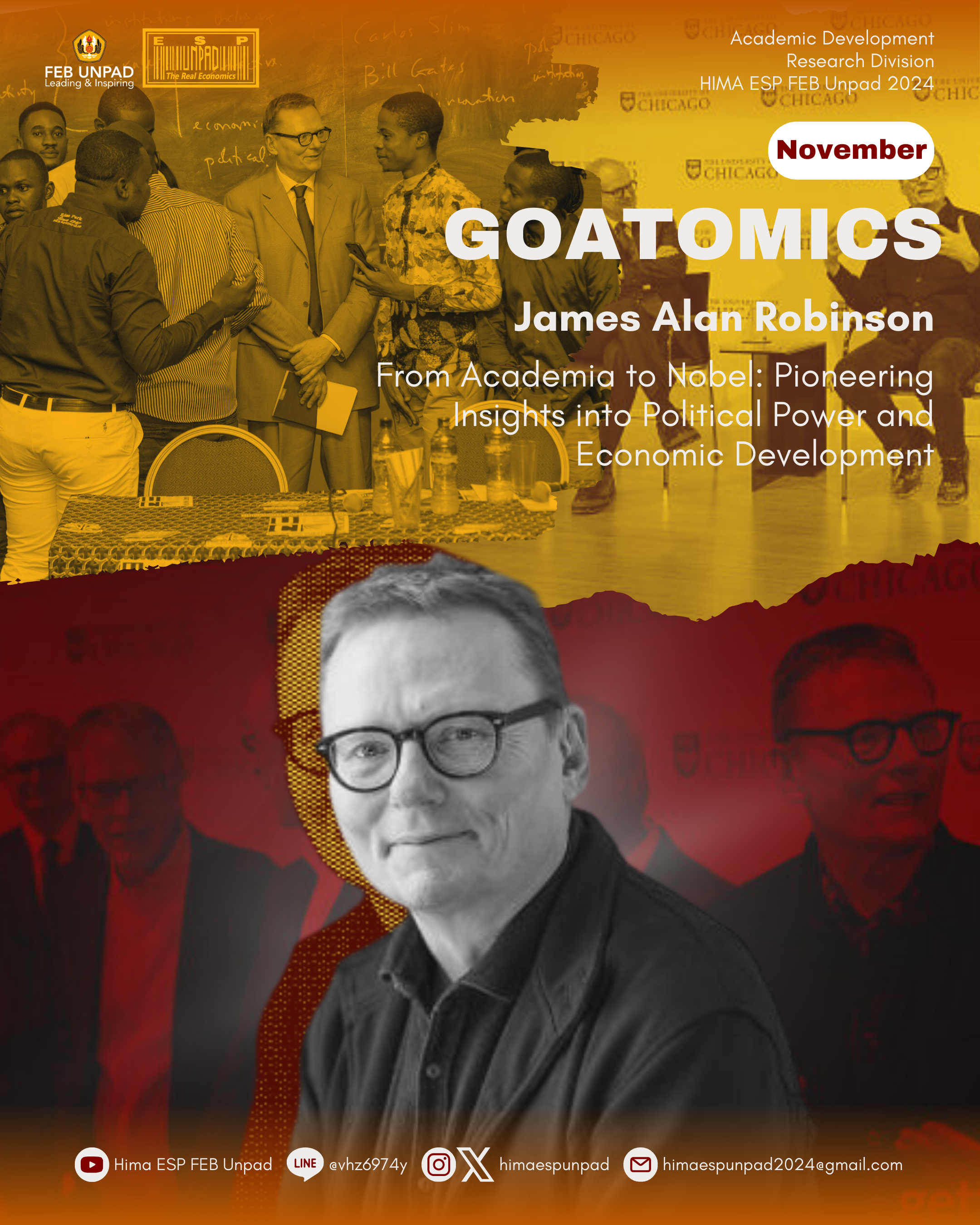
From Academia to Nobel: Pioneering Insights into Political Power and Economic Development
Background
James A. Robinson is a British-American political scientist and economist, who was born in 1960 in the United Kingdom. Robinson acquired his bachelor’s degree in Economics from the London School of Economics and Political Science (1982), master’s and doctoral degrees from the University of Warwick (1986), and Yale University (1993), respectively. He also became a lecturer at the University of Melbourne (1992-1995) and was appointed as assistant professor of Economics at the University of Southern California (1995-1999) and later assistant and associate professor at the University of California, Berkeley (1999–2004).
He was named to endowed professorships at Harvard University in 2009 and 2014. He also became the Reverend Dr. Richard L. Pearson Professor of Global Conflict Studies at the University of Chicago in 2016. James A. Robinson’s research dives deep into how political power and institutions shape economic success, unraveling why some nations flourish while others struggle. He looks at both the big picture and the finer details, blending numbers-driven, mathematical economics with fieldwork, case studies, and qualitative methods. This mix helps him capture the full story—both the data trends and the on-the-ground realities—that reveals why countries’ paths diverge, both in history and today. His work doesn’t just offer insights into the “what” of economic and political development but also gets into the “why,” making it influential for understanding long-term growth and development on a global scale.
Robinson has a deep focus on regions like sub-Saharan Africa and Latin America. He is a fellow at the Institute of African Studies at the University of Nigeria in Nsukka and has taught a summer program at the University of the Andes in Bogotá for nearly three decades, from 1994 to 2022. His extensive fieldwork includes data collection in countries such as Bolivia, Colombia, Haiti, the Democratic Republic of the Congo, Nigeria, Sierra Leone, South Africa, and Zimbabwe.
Robinson has co-authored three influential books with Daron Acemoglu, an Institute Professor of Economics at MIT. Their first book, Economic Origins of Dictatorship and Democracy, presents a theory on the development and resilience of democracies and dictatorships. Their second book, Why Nations Fail: The Origins of Power, Prosperity, and Poverty, has been translated into 41 languages since its 2012 release. It consolidates much of their research on comparative development and offers insights into why some nations thrive while others remain impoverished. Their latest work, The Narrow Corridor: States, Society, and the Fate of Liberty, explores the ongoing struggle between states and societies, uncovering historical forces that have shaped modern governance and liberty worldwide.
James Alan Robinson earned his 2024 Nobel Prize in Economics Sciences with his two partners that have been working for more than 30 years, Daron Acemoglu and Simon Johnson, for their research about how institutions are formed and affect prosperity. In the early 2000s, Acemoglu, Johnson, and Robinson presented their influential perspective on long-term economic development, coinciding with rising dissatisfaction over the lackluster results of 20th-century development strategies.
During the 1960s and 1970s, many economic policies focused on state-led initiatives, which saw some success in instances like South Korea’s heavy industry development. However, by the 1980s, such strategies faced significant criticism, especially after import substitution policies in Latin America largely failed to foster competitive industries, contributing to the debt crises of that decade. The widespread issues of rent-seeking and bureaucratic inefficiency further eroded confidence in state-driven models. The Washington Consensus emerged in light of these failures, advocating for market liberalization and structural reforms. Yet, by the late 1990s and early 2000s, the limitations of this approach became clear, as noted by economists like Joseph Stiglitz.
Scholars have offered various explanations for the shortcomings of previous development policies. Some pointed to the sheer volume of initiatives launched without a scientific basis to evaluate their effectiveness, leading to a push for evidence-based policymaking. This trend was highlighted by the awarding of the 2019 Nobel Prize in Economic Sciences to Abhijit Banerjee, Esther Duflo, and Michael Kremer. Others, like Jeffrey Sachs, argued that wealthy nations failed to provide adequate foreign aid, leaving poorer countries to grapple with geographical disadvantages.
Acemoglu, Johnson, and Robinson proposed a different viewpoint, emphasizing political failures as a critical factor in economic stagnation. While the study of political failures is not new, their work provided fresh insights, demonstrating how historical experiences shape political institutions, which then contribute to the stark economic disparities between rich and poor nations. Their research underscored the role of self-reinforcing historical factors in determining a country’s economic trajectory, illustrating the challenges in altering these paths through development policies. This work has ignited extensive research in political economy, economic development, and economic history.
Impact
Through his incredible works, from his second book called Why Nations Fail, Robinson and Acemoglu can make a significant change by reshaping how economists and policymakers view the causes of poverty and inequality. The book emphasizes that inclusive institutions—those that allow broad participation and safeguard property rights—are crucial for fostering economic growth. By contrasting countries with extractive institutions, the authors argue that political choices, rather than geography or culture, are the key drivers of national prosperity. This has influenced global discussions on development, emphasizing the need for institutional reforms to address poverty and inequality.
Moreover, James A. Robinson also successfully received a prestigious Nobel award in 2024 with his partners Daron Acemoglu and Simon Johnson. Their research emphasizes that the key to economic success lies in “inclusive” institutions that allow broad participation, safeguard property rights, and support equitable economic policies. In contrast, “extractive” institutions concentrate power among elites and hinder growth.
The trio’s work has significantly impacted both academic thought and policy discussions by challenging earlier explanations for wealth disparities between nations, such as geography or culture. Instead, they argue that institutions are crucial in determining whether a society thrives or remains mired in poverty. Their findings have encouraged policymakers to focus on building inclusive political and economic systems as the foundation for sustainable growth and reducing inequality.
Acemoglu, Johnson, and Robinson’s insights are timely, as they are especially relevant to contemporary challenges like the effects of automation, technological change, and political instability. Their work has been instrumental in shaping the global discourse on how nations can overcome economic stagnation and inequality.
Conclusion
James A. Robinson, a distinguished British-American political scientist and economist, has had a remarkable impact on the field of development economics. Born in the United Kingdom in 1960, Robinson’s academic career spans top institutions like the London School of Economics, Yale University, and Harvard University. His research has consistently focused on how political power and institutions influence a nation’s economic development. Together with his long-time collaborators, Daron Acemoglu and Simon Johnson, Robinson has provided groundbreaking insights into why some countries thrive economically while others struggle, making his work widely influential across both academic circles and policy-making discussions.
One of Robinson’s most well-known contributions is his co-authorship of Why Nations Fail, a book that challenges traditional explanations of global economic disparity. Robinson, Acemoglu, and Johnson argue that inclusive institutions—those that promote fair participation and protect property rights—are essential for sustainable economic growth. In contrast, extractive institutions, which concentrate power among elites and limit economic opportunities for the majority, hinder prosperity. This perspective has reshaped how we understand global development, offering a new framework that emphasizes the importance of political and economic institutions over factors like geography or culture. The book has been a critical resource in the ongoing global conversation about how to address inequality and poverty, showing that reforming institutions is key to overcoming these challenges.
In 2024, Robinson, Acemoglu, and Johnson were awarded the Nobel Prize in Economic Sciences for their long-term contributions to the study of institutions and their role in shaping nations’ prosperity. Their work continues to have a profound impact on global policy, urging countries to focus on building more inclusive systems that promote equality and support sustainable development. As issues like technological change, political instability, and inequality continue to shape the global landscape, the trio’s research remains incredibly relevant. Their insights not only inform academic debates but also offer practical guidance for policymakers aiming to create more equitable and prosperous societies around the world.
References
Andersson, T., Fredriksson, P., Svensson , J., Teorell, J., & Rylander, S. (Eds.). (2024). The Sveriges Riksbank Prize in Economic Sciences in Memory of Alfred Nobel 2024. NobelPrize.org; The Nobel Prize. https://www.nobelprize.org/prizes/economic-sciences/2024/popular-information/
Bass, W. (2012, April 24). Book Review: “Why Nations Fail” by Daron Acemoglu and James A. Robinson. Rand.org; The Washington Post. https://www.rand.org/pubs/commentary/2012/04/book-review-why-nations-fail-by-daron-acemoglu-and.html
Dell, M. (2024, October 29). Institutions and prosperity: The 2024 Nobel laureates. CEPR; Voxeu Column. https://cepr.org/voxeu/columns/institutions-and-prosperity-2024-nobel-laureates
Duignan, B. (2024, October 20). James A. Robinson | Nobel Prize, Education, Career, Economic Development, & Facts | Britannica. Encyclopedia Britannica; Britannica. https://www.britannica.com/biography/James-A-Robinson
James A Robinson – James A. Robinson, Reverend Dr. Richard L. Pearson Professor and University Professor, Faculty Director of the Pearson Institute. (2024). Voices.uchicago.edu. https://voices.uchicago.edu/jamesrobinson/The Sveriges Riksbank Prize in Economic Sciences in Memory of Alfred Nobel 2024. (2024). NobelPrize.org. https://www.nobelprize.org/prizes/economic-sciences/2024/summary/
 KANDANK ILMU