Background
Claudia Dale Goldin was born in 1946 in the Bronx, New York, Goldin’s childhood ambition was to become a scientist. Before discovering economics, she studied microbiology. She then pursued an undergraduate degree in economics at Cornell University, where she graduated with a bachelor’s degree in the subject in 1967.
After that, Goldin continued to the University of Chicago to earn a master’s degree in labor economics (1969) and a doctorate (1972) in the same field. Her interest in women’s history in the labor force was sparked by her studies of American economic history, which included the economics of slavery and the post-Civil War South. She also realized that women, families, and children played a considerable role in the significant changes in the labor force during this time.
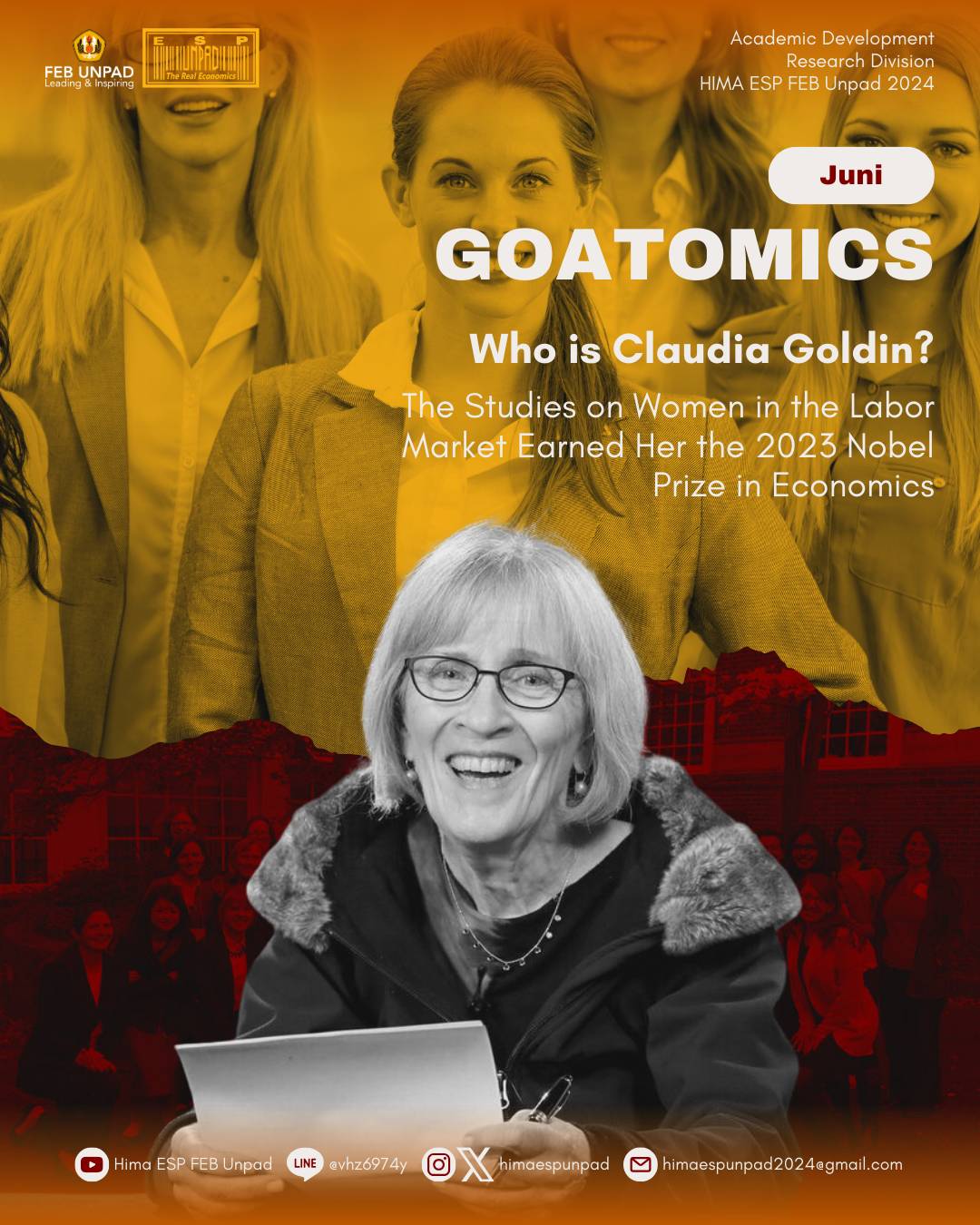
Claudia Goldin’s studies on women in the labor market earned her the 2023 Nobel Prize in Economics. Her corpus of work offers a thorough, historically informed, data-driven overview of gender inequality and proof of the effects of particular adjustments and institutional components. We review her primary conclusions on how women’s employment and incomes have changed over time in light of significant historical occurrences. She recorded a U-shaped labor supply curve throughout time, refuting earlier theories that women’s labor supply and economic development had a steady, positive relationship. Through her study, Claudia brought the rise of factory jobs, service sector jobs, and the contraceptive pill to light. Her research also highlights the persistence of inequality-causing factors, such as high-earning occupations that disproportionately value long hours and a commitment to one job. Her research has sparked new avenues of inquiry and advanced our understanding of this social issue.
Before delving into Goldin’s study findings in greater detail, it is imperative to emphasize the unique qualities of Goldin’s prize in the annals of Nobel Prize winners. For her work advancing our understanding of women’s roles in the labor market—a field of study outside the purview of conventional economics when she began her research—she was awarded the 2023 Nobel Memorial Prize in Economics. Her efforts sparked a growing corpus of literature and raised awareness of an important topic. Only Elinor Ostrom (2009) and Esther Duflo (2019) have won the Nobel Honor in Economics before her; nevertheless, both of them shared the honor (2023). Goldin is the first woman to win the award exclusively for economic research.
Moreover, the Nobel Prize in Economics is rarely awarded to economic historians. Douglas North and Goldin’s supervisor, Robert Fogel, shared the 1993 award as the last economic historian to win one. Goldin fosters the field of cliometrics, a type of economic history in which economic and historical concerns are investigated using the theoretical and empirical tools of economics (Cliometric Society, 2023). Goldin’s job mainly consisted of compiling historical databases. Rather than centering on a central concept or theoretical framework, this work entails diligent, ongoing historical research. Simultaneously, Goldin made a broader contribution to the field of economics with the unified labor supply and demand paradigm that she utilized to analyze historical trends in gender inequality. Her research brought attention to the relationships between markets and households, the implications of self-selection in labor markets, and the role that income and substitution effects play in decisions about labor supply. Additional health, education, personal autonomy, and legal rights disparities have been brought to light by research, and developments in inequality have been linked to industrial structure, overall productivity, and the efficiency advantages of talent allocation.
How Claudia Got the Nobel Prize in Economics
The National Bureau of Economic Research distributed a working paper titled “Why Women Won” to economists worldwide early in 2023. Harvard University’s Claudia Goldin describes how women in American families and workplaces came to have equal rights in her study. It seemed natural that a few hours later, Ms. Goldin was named the recipient of the Nobel Prize in Economics for this year’s advancement of “our understanding of women’s labor-market outcomes.”
Claudia Goldin, the first woman to be granted tenure at Harvard’s economics department, is now the third woman to win the subject’s Nobel Prize. Her research, which provides a comprehensive history of gender labor-market inequality over the past 200 years, has overturned assumptions about both historical gender relations and what is required to achieve greater equality in the present day.
Economists believed more economic growth meant equal opportunities before Ms. Goldin’s research. As manufacturing shifted from homes to factories throughout the Industrial Revolution, married women were driven out of the workforce, as demonstrated by Ms. Goldin. In a study published in 1990, she showed that the more well-known pattern did not arise until the 20th century, at which point high school education and the number of occupations in the service sector increased. As a typical Goldin result, the relationship between the size of Western economies and the participation rate of women in the labor force is u-shaped.
Before Ms. Goldin’s research, many academics believed that questions about historical gender pay gaps were unanswerable due to a lack of data. However, she has repeatedly demonstrated that searching historical archives allows researchers to answer big questions previously thought beyond their reach credibly. Ms. Goldin’s research holds lessons for economists and policymakers. For the former group, it shows the importance of history. Ms. Goldin’s prize is the first Nobel Prize in economics awarded for work mainly in economic history since 1996.
Ms. Goldin’s research shows policymakers that the solutions to gender inequality differ depending on the period and location. For example, in the early 1900s, employers in America forbade married women from finding or keeping jobs. This led to the Civil Rights Act of 1964, which outlawed such behavior. Today, wage gaps remain due to parental norms and greedy employers rather than overt employer discrimination. Ms. Goldin has previously suggested that greater workplace flexibility could solve the issue. Figuring out how to attain it will be her next big gesture.
Development will be slow if young women’s expectations are shaped by the experiences of previous generations, such as their mothers, who returned to work when the children had grown up. This is because educational decisions, which impact a lifetime of career opportunities, are made at a relatively young age. Despite modernization, economic growth, and rising proportions of employed women in the twentieth century, the earnings gap between women and men hardly closed for a long time.
In the past, disparities in education and career choices might have accounted for a large portion of the gender pay disparity. Goldin’s research has demonstrated that most of this wage gap now exists between men and women working in the same profession and mainly develops after the first child is born.
“Understanding women’s role in labor is important for society. Thanks to Claudia Goldin’s groundbreaking research, we know much more about the underlying factors and which barriers may need to be addressed in the future,” says Jakob Svensson, Chair of the Committee for the Prize in Economic Sciences.
Career Path
Goldin’s life path could be more exciting. She studied at esteemed colleges, including Cornell and the University of Chicago. Under the guidance of Robert Fogel—whose mentor was Simon Kuznets, who was awarded the Nobel Prize in 1971—she obtained her PhD from the University of Chicago in 1972 (Nobel Prize, 2023). In addition, she remained in close professional contact with Gary Becker, the 1992 Nobel laureate (Nobel Prize, 2023). She has been a professor at Harvard University since 1990, and according to Goldin (2023), she is the first female tenured professor in the economics department. Several economists besides Goldin have conducted significant studies on the disparities between men and women in the labor market. We might mention Ester Boserup or Gary Becker before Goldin. However, as many works bearing Goldin’s name can be found in every university’s labor economics course syllabus, she is currently regarded as the foremost researcher on this subject (Adamecz Isztin, 2023).
In 1990, Goldin became the first female professor in the Department of Economics at Harvard University. In addition to holding the Lee and Ezpeleta Professorship of Arts and Sciences (2023–1928), Goldin is the Henry Lee Professor of Economics at Harvard University. In addition, Goldin holds the positions of Research Associate at the Institute of Labor Economics (IZA) and Co-Director of the Gender in the Economy Group at the National Bureau of Economic Research.
She belongs to several organizations, including the Society of Labor Economists, the American Economic Association, the American Philosophical Society, the American Academy of Arts and Sciences, the American Academy of Political and Social Science, the Cliometric Society, and the Economic History Association. Among the esteemed periodicals to which she has submitted editorials are the American Economic Review, Journal of Economic History, Journal of Economic Perspectives, Journal of Interdisciplinary History, Quarterly Journal of Economics, and Review of Economics and Statistics.
Goldin has been awarded multiple doctorates by institutions such as Lund University, the European University Institute, the University of Rochester, the University of Zurich, and so on. Among the significant research and teaching honors she has been bestowed are the BBVA Frontiers in Knowledge Award (2019) and the IZA Prize in Labor Economics (2016). She has also received numerous awards for her scholarly publications. On December 8, 2023, she will give the customary Nobel Prize Lecture on “An Evolving Economic Force.”
Impact on the Economic World
Studying labor economics and gender has excellently benefited from Claudia Goldin’s numerous contributions. Notably, in mapping the history of women’s participation in the American labor market, she contributed to a better understanding of what causes the gender pay gap and when it tends to occur. Goldin is an expert in economic history and labor economics. In addition to being the author, co-author, and editor of numerous books, she has written dozens more. Her areas of specialization include women’s labor, contributions to economic development, gender pay gaps, wage inequality, technological advancements, education, and immigration. Most of Goldin’s study explores the beginnings and genesis of contemporary challenges and views the present through the prism of history.
Goldin’s initial focus was on the economic history of the American South. Her first book, Urban Slavery in the American South, 1820 to 1860: A Quantitative History (1976), was her doctoral dissertation. Among her widely cited articles is The Economic Cost of the American Civil War: Estimates and Implications (1975), with F. Lewis. Later, she collaborated with K. Sokoloff on research on early industrialization in the US and the role of women workers, child, labor, immigrant, and working-class families. The article Women, Children, and Industrialization in the Early Republic: Evidence from the Manufacturing Censuses (1982) builds on data from manufacturing firms in 1820–1950 to examine the role of women and children in the industrialization of the American Northeast. It records the substantial labor force participation of women and children. By doing this, Goldin concludes that women have been mostly ignored in the history of the economy. She then examines more closely how the female workforce has evolved and contributed to economic growth.
Conclusion
Born in 1946, Claudia Goldin is a renowned economist who contributed significantly to labor economics and gender inequality. She earned the 2023 Nobel Prize in Economics for her work on women’s roles in the labor market, which has led to a growing corpus of literature and raised awareness of the issue. Goldin’s research has highlighted the persistence of inequality-causing factors, such as high-earning occupations that disproportionately value long hours and a commitment to one job. She has also contributed to the field of cliometrics, a type of economic history that investigates economic and historical concerns using economics’ theoretical and empirical tools. Goldin was the first female tenured professor in the economics department at Harvard University and was awarded multiple doctorates by institutions such as Lund University, the European University Institute, the University of Rochester, and the University of Zurich. Her work has been cite in numerous publications, including her doctoral dissertation on the economic history of the American South.
References
Adamecz, A. – Isztin, P. (2023): (The old big question won a Nobel Prize: why do women earn less than men?) KRTK Blog.
Anna Lovász, J. (2024, March). The Long Road Towards Women’s Equality in the Labour Market – Claudia Goldin’s Research on Historical Trends and Contributing Factors.
https://real.mtak.hu/191971/1/fer-23-1-e1-futo-lovasz.pdf
Bell, E. (2024, March 28). Claudia Goldin: Early Life, Career, Impact, and Nobel Prize.
Finance and economics. (2023, October 9). Claudia Goldin wins the Nobel prize in economics.
Harvard University. (2023). Bio for Claudia Goldin. https://scholar.harvard.edu/goldin/biocv
Nobel Prize. (2024, February 11). Claudia Goldin, Prize in economic sciences 2023: Official Interview.
Sirůček , P & Džbánková, Z. (2024). Winner of the 2023 Nobel Prize for Economics.
 KANDANK ILMU